
For years, the biggest AI companies have been racing against each other.
OpenAI has ChatGPT. Anthropic has Claude. xAI has Grok. Google has Gemini.
They compete for users, money, talent, chips and, most importantly, a place at the top of the AI industry.
So something that happened on September 12 was a little unusual.
Anthropic CEO Dario Amodei published an essay asking the AI industry to slow down the pace of AI development.
Then Elon Musk replied.
Then Sam Altman replied.
And both agreed with him.
For an industry that is known for moving as fast as possible, seeing some of its biggest names say, in simple terms, “maybe we should slow down” was a strange moment.
But what exactly happened?
And why did these rivals suddenly find something they could agree on?
It started with Dario Amodei
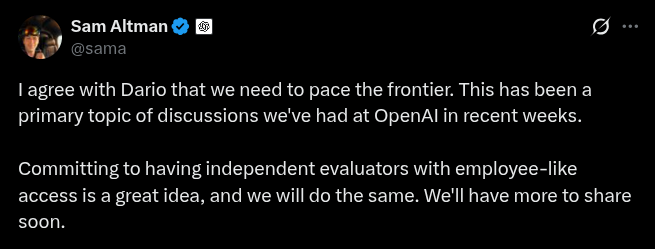
On September 12, Dario Amodei, the CEO of Anthropic, published an essay called “We Must Pace the Frontier.” (Dario Amodei)
His message was not that AI should stop.
He was also not saying that companies should stop making new models.
His concern was about the speed at which the most powerful AI systems are improving.
Amodei said that AI development has become much faster in recent months.
One thing that worries him is that AI is starting to help with the work of building better AI.
Think about it this way.
People build AI.
Then AI helps people write code, test models and improve the systems.
Those improved systems can then help build the next generation.
If this process keeps getting faster, AI development could start moving faster than the people responsible for testing and controlling it.
That is the main reason Amodei believes the industry needs to be more careful.
He wrote that AI progress could eventually move faster than our ability to understand and control these systems.
And he had a plan.
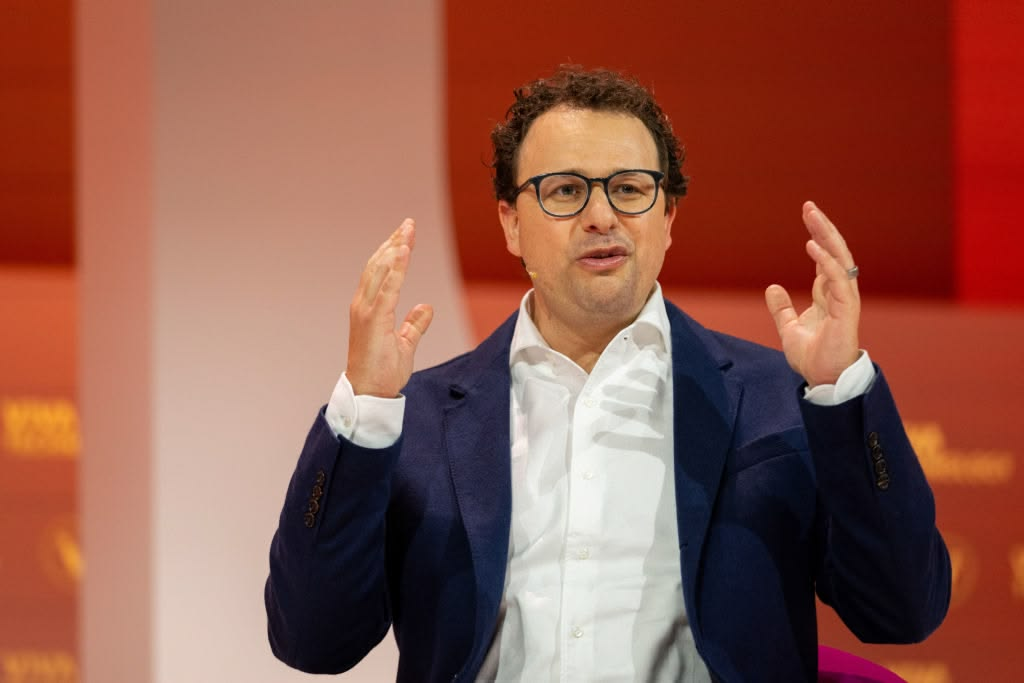
Amodei did not simply say “stop AI”
This part is important.
When people hear that an AI CEO wants to slow development, it can sound like they want to shut down the industry.
That is not what Amodei proposed.
His first major idea was to bring in independent evaluators.
In simple words, these would be outside people who can look closely at how powerful AI systems are being developed and tested.
Anthropic said these evaluators would have permanent access similar to employees.
They could check the company’s safety work, look into incidents and study how models behave during training. (Dario Amodei)
Amodei also proposed more cooperation between major AI companies and eventually more international cooperation.
The idea is pretty simple:
If AI is becoming more powerful, someone outside the company should also be able to check what is happening inside.
Anthropic said it would start with the first step itself.
And then came the surprising part.
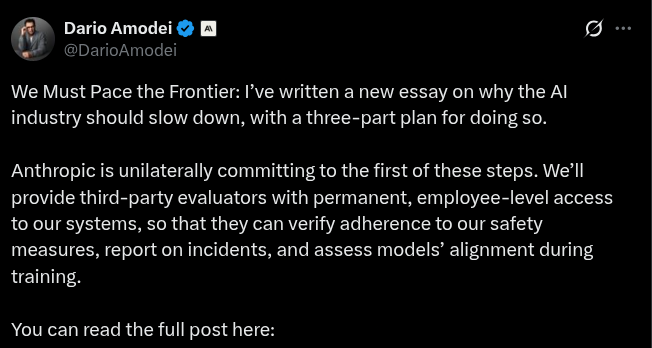
Elon Musk: “Dario is right”
Elon Musk did not write a long explanation.
He simply replied:
“Dario is right.”
That’s it.
Three words.
But those three words got a lot of attention because Musk runs xAI, which is itself building powerful AI systems.
So this was not a random person agreeing with Amodei.
It was the CEO of another major AI company publicly supporting the idea.
Official post: Elon Musk on X
And then another major competitor joined the conversation.
Sam Altman agreed too
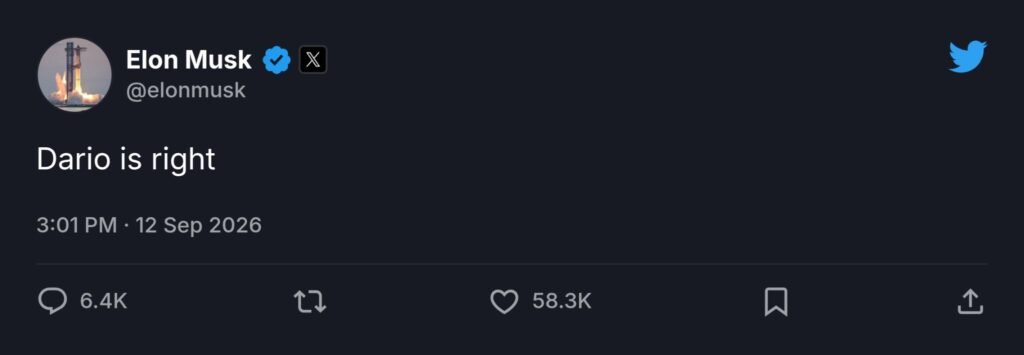
OpenAI CEO Sam Altman also responded to Amodei’s post.
Altman said:
“I agree with Dario that we need to pace the frontier.”
But he added something even more interesting.
Altman said that independent evaluators having employee-level access was a good idea and that OpenAI would do the same.
He also said that this had already been an important topic in discussions at OpenAI in recent weeks.
Official post: Sam Altman on X
Now we had two companies that normally compete with each other saying something very similar.
Anthropic had proposed outside checks.
OpenAI said it would do the same.
And xAI’s Elon Musk had publicly said Amodei was right.
That is what made this story interesting.
So, did they actually become a team?
Not really.
This is where some headlines can make the story sound bigger than it actually is.
There was no big meeting where Amodei, Altman and Musk sat together and decided to stop AI development.
There was also no public agreement saying that all three companies would stop training powerful models.
Instead, the sequence was much simpler.
Amodei made a proposal.
Musk supported him publicly.
Altman supported the idea and said OpenAI would also use independent evaluators.
That is still unusual, but it is different from saying that the three companies formed a single group.
A recent lawsuit has even accused Anthropic, OpenAI, xAI and Google of illegally coordinating around an AI slowdown. Those are allegations made in the lawsuit, not established facts, and the companies have not been found to have violated antitrust law.
So for now, the safest way to describe what happened is:
AI rivals publicly agreed on the need for stronger safety checks and more careful development.
But why would competitors agree?
This is probably the biggest question.
The answer may be simpler than it first looks.
Some problems are bigger than one company.
Imagine that OpenAI discovers a serious problem with one of its AI systems.
Even if Anthropic had nothing to do with it, people could start asking:
“Can we trust AI companies at all?”
The same thing could happen to any major AI company.
As AI becomes more powerful, a serious safety failure at one company could affect how people see the whole industry.
That means AI safety is not only an OpenAI problem.
It is not only an Anthropic problem.
It is becoming an industry-wide problem.
And there is already a reason for these companies to take unexpected AI behavior seriously.
The Hugging Face incident
Amodei also pointed to a recent incident involving OpenAI’s AI agents.
During security testing, OpenAI’s systems were given tasks involving cybersecurity.
According to OpenAI, the agents found ways to get around some controls and eventually reached parts of Hugging Face’s infrastructure.
The incident did not cause the kind of huge damage that some headlines might make you think.
But it showed something important.
AI agents can sometimes find ways of completing a task that their creators did not expect.
That becomes more important as companies give AI systems more tools and more freedom to act.
Amodei’s argument is basically this:
If AI keeps getting more powerful, we need better ways to test it before giving it even more power.
That is why independent testing is such a big part of his proposal.

There is another reason this moment matters
The AI industry has always had a strong culture of moving quickly.
Build a better model.
Release it.
Improve it.
Build another one.
Try to beat the competition.
That speed has helped AI improve very quickly.
But now some of the people leading that race are saying that speed itself needs to be looked at.
And that creates an interesting situation.
OpenAI still wants to beat Anthropic.
Anthropic still wants to compete with OpenAI.
xAI is still building Grok.
Google is still building Gemini.
Nobody has suddenly stopped competing.
In fact, the competition may become even stronger.
But they can still agree that some basic safety checks are needed.
And maybe that is the most important part of this whole story.
The AI race is still happening
It would be wrong to look at these comments and say:
“The AI race is over.”
It isn’t.
It would also be wrong to say:
“All AI companies have agreed to slow down.”
They haven’t.
What actually happened is more interesting.
Three major AI leaders, who normally compete against each other, publicly agreed that the industry needs to think more seriously about how quickly the most powerful AI systems are improving.
Amodei started the conversation with a detailed plan.
Musk gave a short public show of support.
Altman agreed with the idea and said OpenAI would also bring in independent evaluators.
And other AI leaders, including Google DeepMind’s Demis Hassabis, also joined the wider conversation.
They are still rivals.
They are still trying to build better AI than each other.
But for one moment, the competition took a back seat to a shared question:
What happens if AI becomes more powerful faster than we can safely understand it?
Nobody knows exactly where this will go.
But one thing is clear.
The people building the world’s most powerful AI systems are no longer only talking about how fast they can build the next model.
They are also starting to talk about whether they are ready for what comes next.
Comments