
Artificial intelligence is growing faster than ever. Every major tech company wants to build smarter AI models, offer better services, and reduce the cost of running them. One of the biggest parts of this race is not just software anymore. It is the hardware that powers AI.
According to recent reports, Meta is preparing to begin manufacturing its own AI chip called Iris this September. While Meta has already invested billions of dollars in AI research and large data centers, building its own AI chip could be one of its biggest moves yet.
If the reports are correct, Iris could help Meta become less dependent on companies like Nvidia while giving it more control over its AI future.
Why Is Meta Building Its Own AI Chip?
Today, most AI companies depend on powerful graphics processing units, or GPUs, to train and run AI models. Nvidia is currently the biggest supplier of these AI chips, and its products are used by companies such as OpenAI, Microsoft, Google, Amazon, and Meta.
The problem is that these chips are very expensive and often difficult to get because demand is so high.
Meta spends billions of dollars every year on AI infrastructure. That includes buying thousands of AI chips, building new data centers, and running large AI models for products like Facebook, Instagram, WhatsApp, and its AI assistant.
By creating its own chip, Meta hopes to reduce costs over time and improve performance for its own AI systems.
Instead of depending completely on another company, Meta can design hardware that fits exactly what its AI models need.
What Is Iris?
At this stage, Meta has not officially shared many details about Iris.
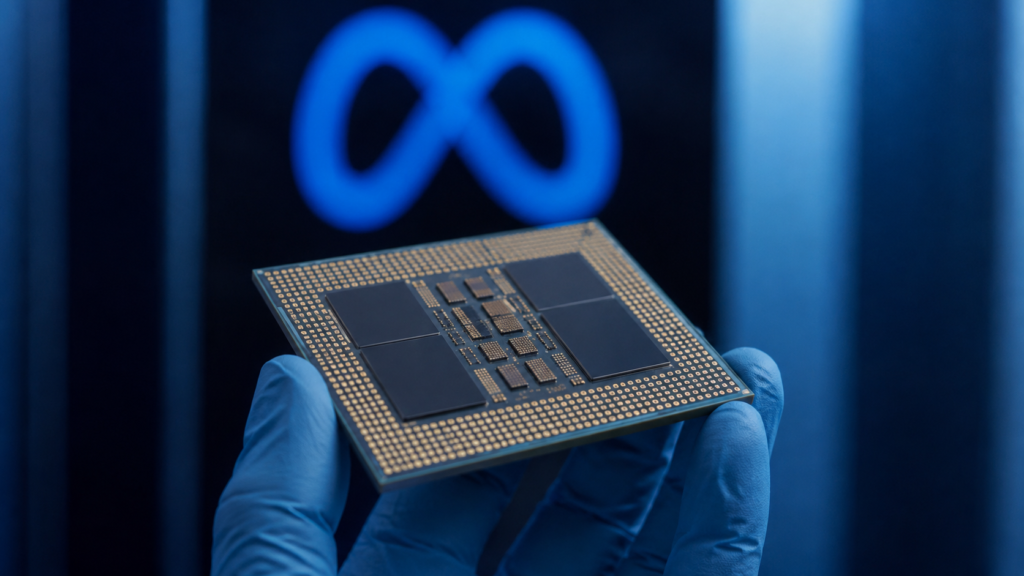
Based on reports, Iris is expected to be an AI chip designed specifically for machine learning and AI workloads. Rather than trying to replace every type of processor inside a computer, Iris will likely focus on tasks such as running AI models, handling recommendations, generating content, and processing large amounts of data.
Custom AI chips are becoming more common because they are designed for a specific purpose. This often makes them more efficient than general-purpose hardware.
If Iris performs well, it could become an important part of Meta’s AI infrastructure over the next few years.
Why Are Custom AI Chips Becoming Popular?
Many technology companies are now building their own AI hardware instead of relying only on outside suppliers.
Google has its Tensor Processing Units (TPUs), which are used to power many of its AI services.
Amazon has developed its Trainium and Inferentia chips for cloud AI workloads.
Microsoft is also investing in custom AI hardware for Azure.
Now Meta appears to be following the same path with Iris.
The main goal is simple. Companies want better performance, lower operating costs, and greater control over their AI systems.
Instead of waiting for another company to release new hardware, they can design chips that match their own software and data centers.
How Could Iris Help Meta?
If Iris delivers strong performance, it could provide several important benefits.
First, Meta may spend less money on buying third-party AI chips in the future.
Second, custom hardware could improve the speed and efficiency of AI services across Meta’s platforms.
For example, AI features on Facebook, Instagram, WhatsApp, and Meta AI could become faster while using less power.
Third, Meta would have more flexibility when expanding its AI infrastructure.
As AI models continue to grow, companies need thousands or even hundreds of thousands of chips working together. Having an in-house solution gives Meta more control over production, deployment, and future upgrades.
Will Meta Stop Using Nvidia?
Probably not.
Even if Iris enters manufacturing this year, Nvidia’s GPUs will likely remain a major part of Meta’s AI infrastructure for a long time.
Training the largest AI models requires enormous computing power, and Nvidia still leads the industry with some of the fastest AI hardware available.
Instead of replacing Nvidia completely, Iris may work alongside Nvidia chips.
This mixed approach allows Meta to use its own hardware where it makes sense while continuing to rely on Nvidia for workloads that need maximum performance.
Many large technology companies already use a similar strategy.
What Does This Mean for the AI Industry?
Meta’s move shows that AI is no longer only about building better software.
The companies leading the AI race are now investing heavily in hardware as well.
Designing custom chips gives companies more control over performance, energy use, and long-term costs.
This trend is expected to continue over the next several years as AI models become larger and more powerful.
For chip makers, competition is also increasing. Nvidia remains the market leader, but companies such as AMD, Intel, Google, Amazon, Microsoft, and now Meta are all investing in AI hardware.
This competition could lead to faster innovation and better technology across the industry.
Challenges Ahead
Building a successful AI chip is not easy.
Designing the hardware is only one part of the process. Manufacturing advanced chips requires specialized factories, complex testing, and close work with manufacturing partners.
Software also plays a huge role.
Developers need tools that allow AI models to run efficiently on the new hardware. Without strong software support, even powerful chips may struggle to gain widespread use.
Meta will also need to prove that Iris offers meaningful improvements over existing solutions.
Performance, power efficiency, reliability, and cost will all be closely watched once more information becomes available.
Looking Ahead
If manufacturing begins as reported this September, Iris could become an important step in Meta’s long-term AI strategy.
The company has made it clear that artificial intelligence will remain one of its biggest priorities for years to come. Building its own AI hardware fits naturally into that vision.
While many questions remain about Iris, the move highlights a larger trend across the technology industry. Companies are no longer satisfied with buying off-the-shelf hardware. They want to build complete AI ecosystems, from the software users interact with to the chips running inside massive data centers.
Whether Iris becomes a major success or simply supports part of Meta’s AI operations, it reflects how competitive the AI industry has become.
One thing is certain. The race to build the future of artificial intelligence is no longer just about creating smarter models. It is also about creating the hardware that powers them. As Meta prepares to begin manufacturing Iris, the next chapter in the AI chip race is getting even more interesting.
Comments