
Introduction

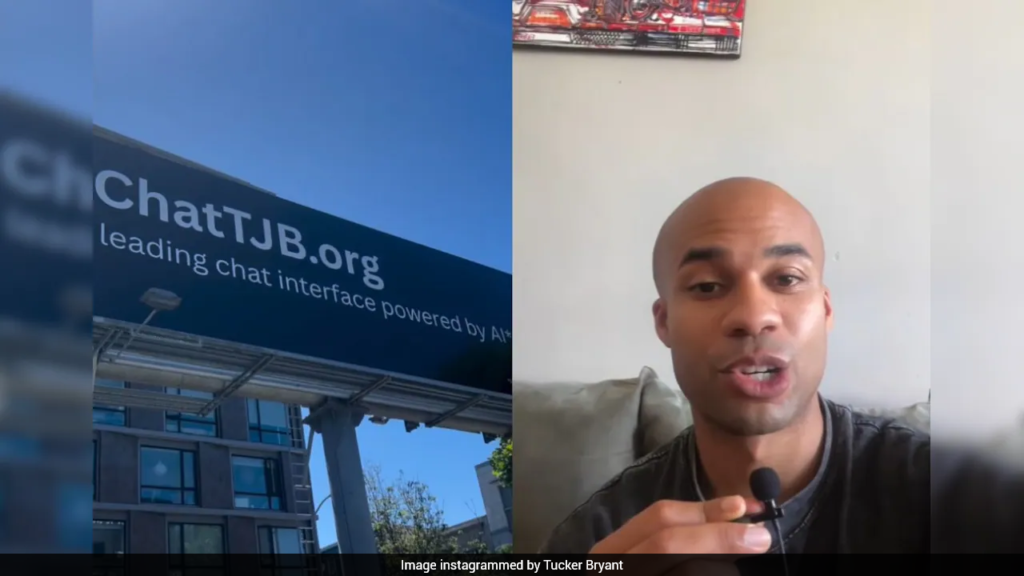
On July 27, a big new ad went up on the corner of Sixth and Folsom in San Francisco. It was 14 feet tall and 48 feet wide, and it said that something called ChatTJB was the leading chat interface powered by AI.
In that city, this is about as normal as a bus stop. Ads for AI products are everywhere. People walk past them without looking up.
But this one had a small asterisk. And next to the asterisk, in tiny letters, was the punchline: AI here meant “Average Individual.”
The average individual was Tucker Bryant, a 32-year-old former Google project manager who now works as an artist and public speaker. TJB are his initials. There was no model behind the website. There was no server farm. There was just Bryant, sitting at a computer, reading what strangers typed and typing back.
He paid $6,000 for the billboard. Fittingly, it was a bad spot. Trees blocked part of the sign, including a chunk of the disclaimer, and there was barely any traffic that could see it properly.
How it worked
The site, ChatTJB.org, looked like every other chat tool you have used since ChatGPT arrived. A blank box. A blinking cursor. Type your question and wait.
The waiting part was different. Sometimes it took minutes. Sometimes hours. Bryant built the thing over a weekend using a vibe-coding tool, then spent his days answering people by hand, up to ten hours at a stretch.
Ask him what to cook for dinner and he would tell you. Ask what colour to paint your living room and he would guess. Ask for relationship advice and, brave man, he would offer some. He even handled image requests. If you wanted a rabbit in sunglasses, you got a quick sketch, drawn by a person, in whatever time he had.
The about page called it handcrafted work made by one human being. A note at the bottom of the site said the whole thing was satire and a public art project, and also, seriously, a real chat service run by a real person. It also mentioned that it was not an investment opportunity, which tells you something about the emails he must have been getting.
Why he did it
The idea did not start with the billboard. It started with sleeves.
Bryant had lived in San Francisco for seven years. One day it was 65 degrees outside and he found himself asking an AI whether to wear short sleeves or long ones. He knew the answer. He had known it for seven years. He asked anyway.
His partner told him there was a name for that habit. Two Wharton researchers, Steven Shaw and Gideon Nave, had been studying it and called it cognitive surrender. Their finding is worth sitting with. People who used AI help did better than people working alone, as long as the AI was right. When the AI was wrong, those same people did far worse than the ones who got no help at all. About 15 percentage points worse. They stopped checking.
Bryant is not anti-AI, and he has said so repeatedly. He is not trying to shut anything down or convince you to cancel your subscription. He just wanted to build something that made people slow down and notice they were trusting an answer without reading it properly.
So he built the worst possible version of a chatbot. Slow, unreliable, sometimes wrong, and definitely not available at three in the morning.
Then it got out of hand
For three months, almost nothing happened. He launched in April and the site sat there collecting a trickle of questions, maybe a hundred a day.
The billboard changed that. Photos of it spread on Instagram, then the press picked it up, and then the queue exploded. In the first week after the sign went up, he counted around 15,000 prompts from about 11,000 people. Within a couple of weeks the total had passed 100,000. At the busiest point, questions were arriving at more than 5,000 an hour.
One man with a keyboard cannot do 5,000 an hour. One man cannot do 500. Bryant has mostly stopped answering now and has asked for help instead.
Here is the part nobody planned. More than 10,000 people volunteered to be Average Individuals and answer strangers’ questions for free. The waitlist has been growing by roughly a thousand people a day.
Think about what that means for a second. For years the fear has been that software would take people’s jobs. Bryant accidentally created a job that does not pay, has no title and involves pretending to be software, and thousands of people lined up for it.
The messages got real
The strange thing about a joke chatbot is that people started using it properly.
The message Bryant keeps mentioning came from someone on the first night of their honeymoon. They wrote in to say they did not feel completely relaxed, and asked whether that was normal.
That is not a prompt. That is a person quietly asking another person if they are okay. Bryant has said that was the moment the project stopped being pure satire and turned into somewhere people came to talk to a well-meaning, ordinary human.
You cannot really test that message on a benchmark. Someone typed it into a website knowing a stranger would read it, and waited.
What to make of it
It is tempting to read this as proof that everyone secretly wants technology to be slower. Shaw, one of the researchers behind the term that inspired the project, pushed back on that. People do not want worse tools, he said. ChatTJB is art, and art gets to make a point that a research paper cannot.
Researchers have tried various ways to stop people from switching their brains off around AI, including time pressure, rewards and feedback. None of it worked well. Other teams have tested deliberately slowing systems down or making them ask questions back. The problem is obvious. Add too much friction and people just leave for something faster.
Bryant did not solve that. He never claimed to. He rented a bad billboard in a bad spot, told a joke about the word AI, and then answered thirty thousand strangers one at a time until his hands hurt.
He says it is a short-term project, though he would talk to the right partner about keeping it alive. Either way, the point already landed. For a few weeks this summer, a lot of people typed a question into a box, waited a long time, and got an answer that a person had actually thought about.
Not a great answer, necessarily. But a real one.
Comments