
Artificial intelligence has moved into another part of everyday life, and this time it is inside an operating room.
Surgeons in London have used artificial intelligence to help guide them during brain tumor surgery while the operation was happening. The system watched live video from the surgical camera and helped the doctors identify important parts of the brain around the tumor.
The operation was carried out at the National Hospital for Neurology and Neurosurgery, part of University College London Hospitals. According to UCLH, it is the first known use of AI to support a neurosurgeon in real time during live surgery.
The patient, 48-year-old Rhys Hibbert from Bedfordshire, had a small tumor in his pituitary gland. The tumor was around 11 millimeters in size, but its location made the operation extremely delicate. It was close to nerves that control vision as well as important blood vessels.
The goal was not simply to remove the tumor. Surgeons also had to avoid damaging the nearby structures that could affect his eyesight or cause much more serious problems.
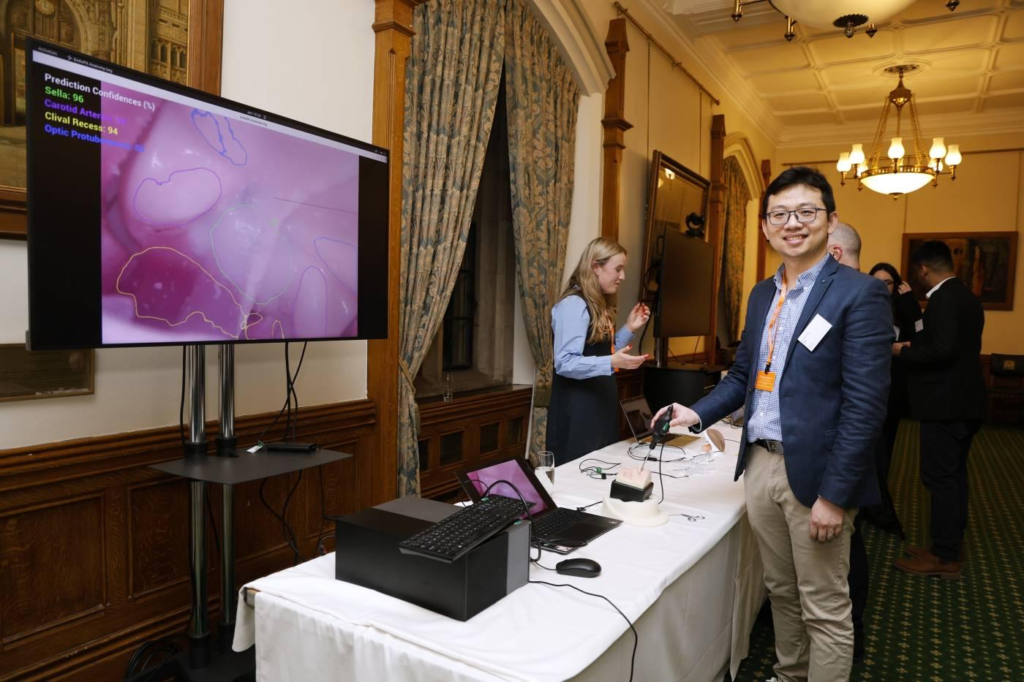
That is where the AI system came in.
The AI was watching the surgery as it happened
AI has already been used in medicine for things such as reading scans, finding signs of disease and helping doctors plan treatments.
This was different.
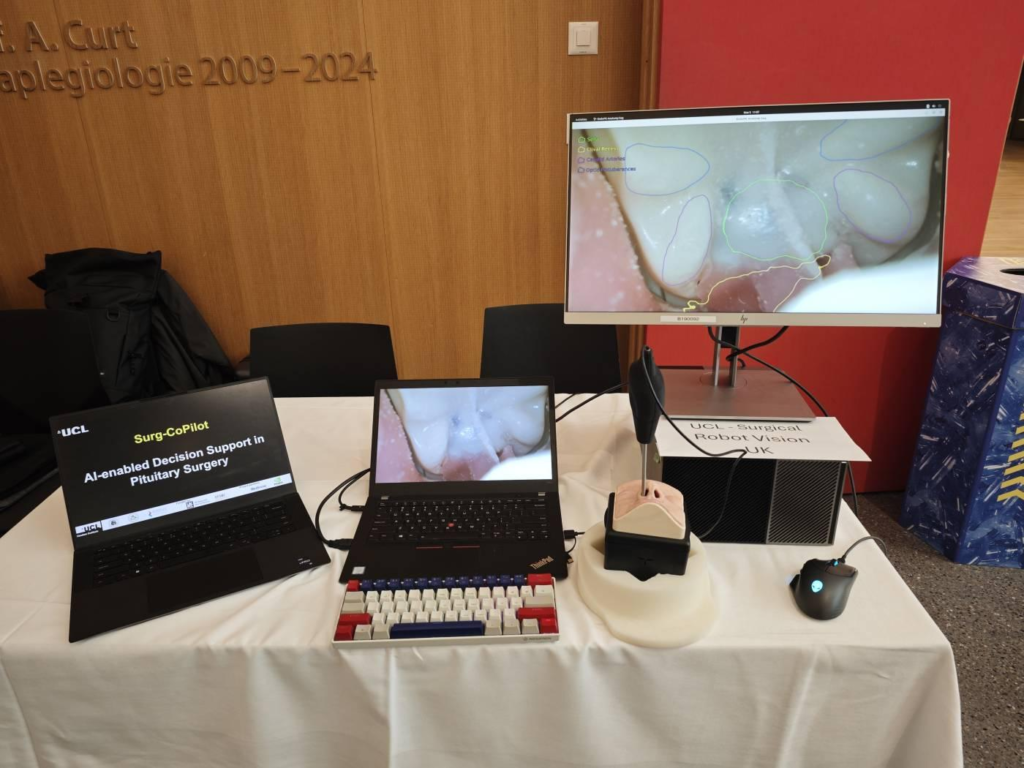
Instead of looking at an old scan before the operation, the AI system was connected to the live video coming from the surgical camera. As the surgeon worked, the system analyzed what it could see and helped highlight important structures around the tumor.
The system was designed to recognize things such as nerves, blood vessels, surgical instruments and different types of tissue.
For the doctors, this meant they had another source of information while working in a very small and difficult area.
The surgeon was still making the decisions. The AI did not operate on the patient, move the surgical tools or decide where the surgeon should cut.
It acted more like an extra set of eyes.
That difference is important because the idea of an AI performing brain surgery by itself is still far from reality. What happened in London was much more controlled. The surgeon remained in charge throughout the procedure, while the AI provided information that could help during the operation.
A tiny tumor in a very difficult place
Hibbert’s tumor was located in the pituitary gland, a small gland at the base of the brain.
The area around it is packed with important structures. The nerves responsible for vision are nearby, along with blood vessels and other parts of the brain.
That leaves surgeons with very little room for error.
According to UCLH, even a difference of around one millimeter in this area can have serious consequences. Damage to the wrong structure could lead to blindness, stroke or even death.
Hibbert had already started to experience problems with his vision.
His tumor was first discovered after he suddenly collapsed during a walk in December 2024 and suffered a seizure. Further tests found the tumor. At first, doctors managed his condition without surgery, but his symptoms later became worse.
His vision was one of the biggest concerns.
He had started losing part of his field of vision and even needed walking sticks after repeatedly tripping because he could not properly see the area below him.
Eventually, he decided to have surgery.
Then he was given another choice. He could take part in the clinical research testing the live AI system.
He agreed.
The patient wanted to help future patients
Hibbert’s decision is an important part of the story.
He knew that taking part in a new medical trial came with risks, but he also believed that research could not move forward without patients willing to participate.
He volunteered to become the first patient to have this type of AI support during his operation.
For him, it was not only about his own treatment. He also wanted the experience to help doctors understand whether this technology could be useful for other patients in the future.
That makes the story less about a machine replacing a doctor and more about doctors finding another tool that could make difficult operations safer.
What happened after the operation?
The early result was encouraging.
According to UCLH, the surgery successfully removed the tumor while protecting Hibbert’s vision.
He said that when he woke up after the operation, his vision had dramatically improved. Within a week, he was walking independently without his walking sticks.
That was a major change from what he had experienced before the operation.
Hibbert is now recovering and slowly increasing the length of his walks. He hopes that taking part in the trial will help researchers improve the technology and eventually help other patients.
Of course, one successful operation does not mean AI-assisted brain surgery is ready to become common everywhere.
There is still a lot of work to do.
How was the AI trained?
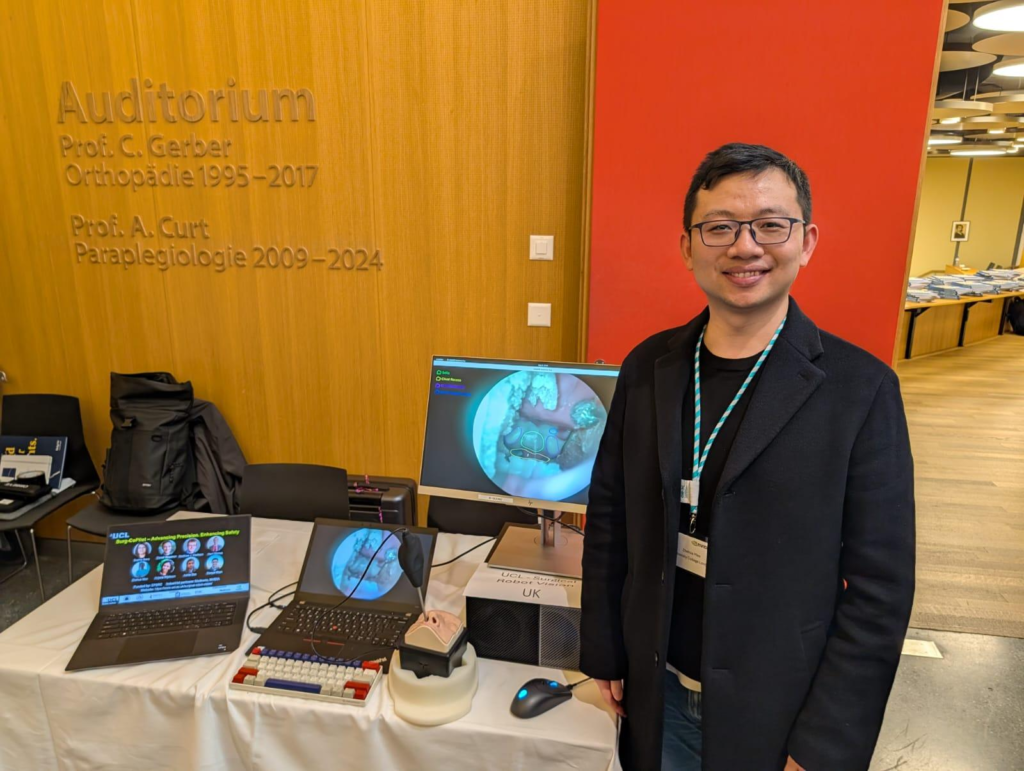
The system was developed by researchers at University College London through the UCL Hawkes Institute.
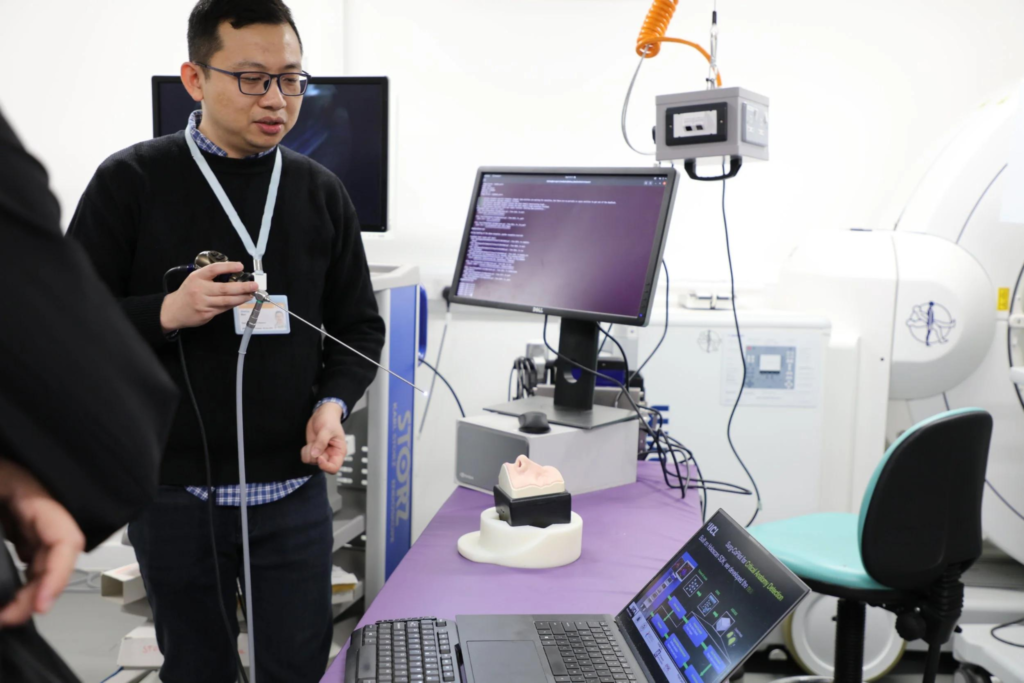
Researchers trained the AI using hundreds of videos from earlier endoscopic pituitary surgeries. These videos had been marked up to show important parts of the operation.
The idea is fairly simple.
The more examples the system sees, the better it can learn what different parts of the surgical area look like.
A surgeon may spend years seeing different cases during training and practice. An AI system can process a large collection of recorded surgeries and learn patterns from them.
But that does not mean the AI understands surgery in the same way a human surgeon does.
It is recognizing patterns in images and video. The human medical team is still responsible for understanding the patient, judging the situation and deciding what to do.
That human control remains one of the most important parts of the system.
This could become more than a brain surgery tool
The researchers believe the technology could eventually do more than highlight important parts of the brain.
The system can also be developed to track surgical instruments and understand how instruments interact with tissue.
That could give surgeons more information during complicated operations.
It could also have another use outside the operating room.
The technology has previously been tested as a training tool for surgeons. In the future, similar systems could potentially help doctors learn how to identify difficult anatomy and understand what they are seeing during surgery.
That could be especially useful for younger surgeons who have not yet seen a large number of complex cases.
Still, there is a big difference between a system being useful in research and being trusted in hospitals around the world.
More testing is needed.
AI is becoming an extra set of eyes for doctors
The biggest point from this operation is not that a robot has learned how to perform brain surgery.
It has not.
The more interesting development is that AI can now watch a live operation and provide useful information to a surgeon while the surgeon is working.
That could become important in areas where the human eye has to identify very small structures under extreme pressure.
Doctors already use cameras, scans, navigation systems and many other tools during surgery. AI could become another part of that collection.
And unlike a normal screen showing an image, an AI system can actively analyze what is appearing on the screen and point out things that may matter.
That could eventually reduce some risks during difficult operations.
But the technology needs to prove that it can do this safely and consistently.
The London operation is an important first step, not the final answer.
A glimpse of what surgery could look like
For years, AI in healthcare has mostly been discussed around medical scans, diagnosis and drug research.
Now it is beginning to move closer to the actual moment when treatment happens.
The London operation shows one possible future.
A surgeon could be looking directly at a patient’s anatomy while an AI system watches the same view, identifies important structures and provides extra information when it is needed.
The doctor still makes the final call.
The machine simply helps the doctor see more.
For Hibbert, that technology arrived at a very important moment in his life. His tumor threatened his eyesight, and he chose to become part of an experiment that could help shape the future of surgery.
His successful recovery does not prove that AI will make every operation safer. But it does show that AI can now play a role in one of the most difficult environments in medicine.
The next question is how far this technology can go.
If further trials show that it is safe and useful, live AI assistance could eventually become a normal part of some complex surgeries.
For now, though, the message from London is much simpler.
The surgeon is still holding the instruments. But for the first time, an AI system was watching the operation alongside them.
Source: University College London Hospitals, “First patient in live AI assisted sight-saving brain surgery”
Comments